Reading
Why isometric still works
The view is not nostalgia. It solves a problem 3D does not, and the problem has not gone anywhere.
Isometric is a lie about geometry and your eye lets it through without comment. There is no vanishing point. Lines that are parallel in the world stay parallel on the screen. A chair in the far corner is drawn at exactly the same size as a chair by the door. Nothing you have ever looked at works like this and nobody has ever complained about it.
What you get in exchange is the whole room in one glance.
The glance is the entire feature
A 3D room has to be toured. You walk in, turn around, look up, and after a few seconds you have a rough model of the place in your head. An isometric room arrives complete. Every object, every person, every gap in the furniture, all of it in the first frame, before you have moved.
That is why furniture mattered so much in Habbo and why it has never quite mattered as much anywhere else. A decorated isometric room says something about the person who made it, and a stranger reads all of it at once. In a first-person world the same work gets discovered slowly, by one visitor at a time, and most of it is behind them at any given moment.
You can see who is standing next to whom
This is the part people miss when they call isometric a graphics choice. It is a social one. In an isometric room the shape of the conversation is legible. Who is in the circle. Who is on the edge of it. Who walked over to the corner with one other person and stayed there. Standing next to somebody is a statement, and everyone in the room can read it without asking.
Try to have that in first person. You cannot see yourself. You cannot see the shape of the group without turning your head through it, and by then it has changed. The information is technically present and practically gone. Every social world that went 3D lost this quietly and replaced it with a list of names down the side.
One person can make a couch
A tile is a diamond. A couch is a picture of a couch. There is no lighting rig, nothing to unwrap, no rig to weight, no normal map to bake. That is the real reason the fansite scene existed. Teenagers made furniture in image editors and it looked like it belonged, because looking like it belongs is a much lower bar when the whole world is drawn rather than lit.
The economics of that have not changed. A 3D asset for a social world is a small production with several steps and at least one specialist. An isometric one is an afternoon. If you want a world where the people in it make the things in it, the view you pick decides whether that is even possible.
The grid decides for you
A thing is on a tile or it is not. There is no half a tile. Nothing clips into anything, nothing floats a centimetre above the floor, nothing needs nudging with an arrow key. Building in an isometric room feels good specifically because the rules are simple and have no exceptions, and that is rarer in software than it ought to be.
Free placement always sounds better in a feature list and always ends with somebody spending twenty minutes getting a lamp to sit properly on a table. The grid takes that decision away and hands you back the twenty minutes.
What it costs
I am not going to pretend the view is free. You cannot look up. There is no sky worth having and no inside of anything. The camera does not move, so a room can never surprise you, which means the second time you enter a room it is exactly the room you remember. The diagonal walk is a lie about distance and you notice it the first time you race somebody across a floor. And scale reads as area rather than as height, so an isometric cathedral is just a wide room.
Those costs are why 3D won everywhere else. They are also why isometric keeps coming back for the one specific job of holding a group of people in a place they built.
Both, if you can have both
The world I build renders the same room in both, and switching is one control, so I have spent an unusual amount of time looking at the trade directly. The 3D view is better for being somewhere. You feel the height of the tower, you can stand under a tree, you walk through a doorway instead of clicking past it. The isometric view is better for being with people. Every time I have watched somebody use both, they build in isometric and then go and stand in 3D to look at what they made.
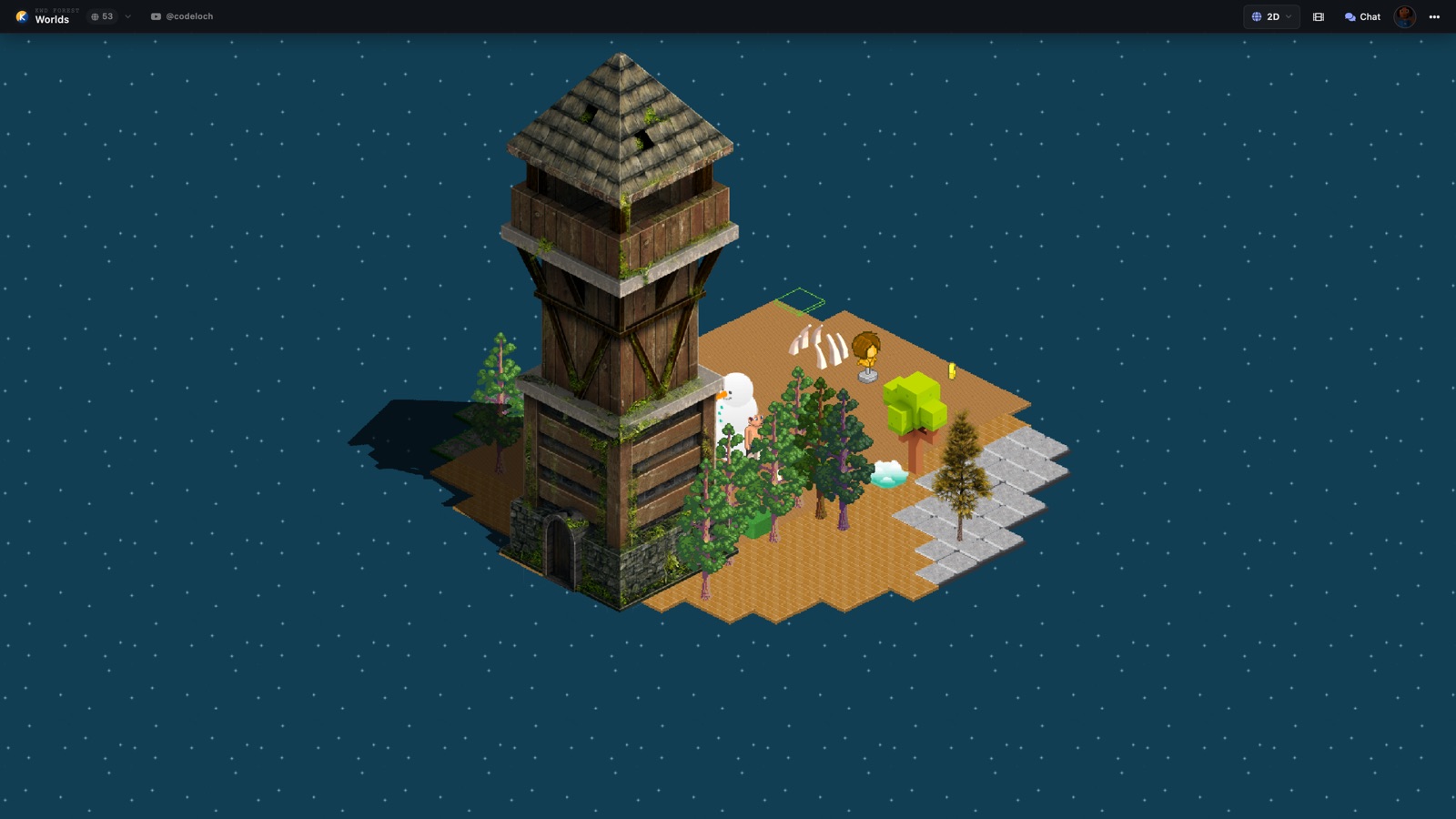

That is the honest summary of twenty-five years of this argument. One view tells you where you are. The other tells you who you are with. Habbo picked the second and got a generation out of it.
Isometric did not survive because people are sentimental. It survived because a room full of people is information, and this is still the cheapest way anyone has found to draw it.